

Friday Morning Outdoor Painting Group
Plein Air Painting in Adelaide, SA
Tips and Ideas
on outdoor equipment and techniques
Stretching and Flattening Paper
I have prepared this summary of my experience with preparing and treating paper for watercolour, drawings and prints, in case it may be useful to others.
Tony Wynne, October 2025
Choice of Paper
For outdoor watercolour, I now prefer unstretched, medium-weight paper (180–220 gsm), as it dries faster and gives a more vibrant result than stretched or heavier papers. I also use 300gsm paper, which does sometimes also need to be flattened.
Buckling is minimized by not fastening all the way around with tape, but by using only a few masking tape ‘tags’. This allows the paper more freedom to expand without buckling, but the finished watercolour will usually need to be flattened. If a clean edge is needed, fasten masking tape around the perimeter of the paper only, with a few ‘tags’ to fasten it to the board.
For printmaking, I nearly always dampen the paper first. I sometimes use thin rice papers for prints and wash drawings, and these thin papers can be especially difficult to flatten.
Stretching and/or dampening paper
Aim to stretch or soften the paper without washing out the size (glue), especially for watercolour. So, do not leave it to soak, but use just enough water to adequately dampen the paper. I prefer dampening with steam, humidity, or a spray bottle, then pressing between glass or other impermeable sheets with a weight on top.
For steam/humidity – use a large, sealable container in which to hang the paper or artwork, into the bottom of which one can pour boiling water – a large household rubbish collection bin is ideal. Putting a towel over the top, under the lid, will prevent condensation drops, especially for a finished work.
Thin paper can tear if it is too wet and stretched using gum tape. The brown gum tape is not acid free, and it should be either cut off or soaked off before a painting is framed, so allow space to cut it off. The white, acid-free gum tape can be left on.
If stretching thin paper with the artwork, either dampen with humidity or wet the back only. Thin papers can form tight ripples if dried under weights, so pin the damp artwork, image up, onto a pin-board (sealed to prevent acid transfer), with drawing pins at 2 cm spacing. A strip of heavy paper under the pins helps spread the pressure and avoid rust marks.
Don’t leave damp paper in a warm environment for too long, or it will go mouldy. If you need to keep it damp, wrap it in plastic and store in the fridge.
Flattening watercolours and prints
This is the method I use to flatten watercolours on medium weight paper, and prints (except those on very thin paper)
Lay the artwork face down on an impervious surface such as plate glass;
Lightly spray the back, wipe with a barely damp sponge to even out, cover with another sheet of glass, and a weight such as a few books, and leave for 30 minutes;
Dry the artwork by placing the damp, soft, flat paper between blotters or absorbent tissue paper and several layers of newspaper, place between thick mdf or particle board and apply weights (e.g. 5-10kg) for several hours or days, perhaps replacing the blotters and newspaper part way through.
Printing on damp paper
Most printmakers dry prints on racks and if they need flattening, they do this later. However, for the home printing studio the following may be more convenient.
After printing on damp paper, let the prints partly air-dry on an absorbent surface, such as a towel or carpet, for 1 to 4 hours.
Place the still slightly damp prints between blotters and newspaper. The ink is usually dry enough not to print onto the blotting paper.
For intaglio prints, use less pressure to preserve plate marks and embossment of the inked lines.
Lithographic ink takes longer to dry, so for lithographs, it may be better to allow the prints to dry thoroughly before re-wetting and flattening.
Irons do not work
Using a clothes iron to flatten paper doesn’t work, it can make buckling worse.
Masking Tape for White Borders
If an artwork is to be displayed with a white border, it is best to create the artwork with the border present, as it affects colour perception, tonal balance, and composition.
Using strongly coloured masking tape distorts colour perception, which becomes evident when it is removed.
Ordinary beige coloured masking tape is fairly neutral, but it can damage paper if left on more than a few days.
Therefore low-tack tapes are preferred, but hardware stores are limited to strong colours. White tape is listed on several overseas art supply stores.
Low tack transparent ‘magic’ tape is not suitable for watercolour, as the colour creeps under the edge.
Painting to a ruled edge is one alternative, but it can be difficult.
For dry media, such as pencil and charcoal:
• ‘magic’ tape is suitable, but expensive;
• coloured masking tape causes less problems than for works in colour;
• a flat straight edge and eraser may also work.
If removing masking tape is difficult, heat it with a hair-dryer on high heat and low fan, moving the drier just ahead of where the tape is being removed.
Drawing a straight line
I remember Pat saying to me that if you want to draw a straight line freehand, don’t look at the end of the pencil, look at where you want the line to go.
Margaret
Easel Tray
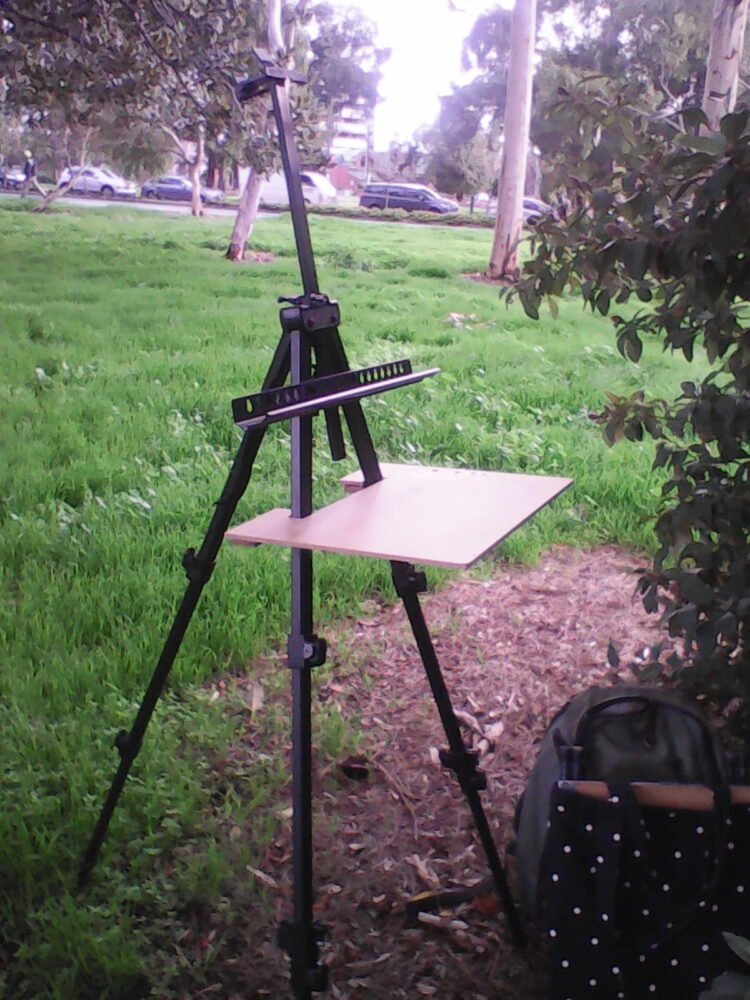
Most portable easels lack a tray to hold drawing or painting materials.
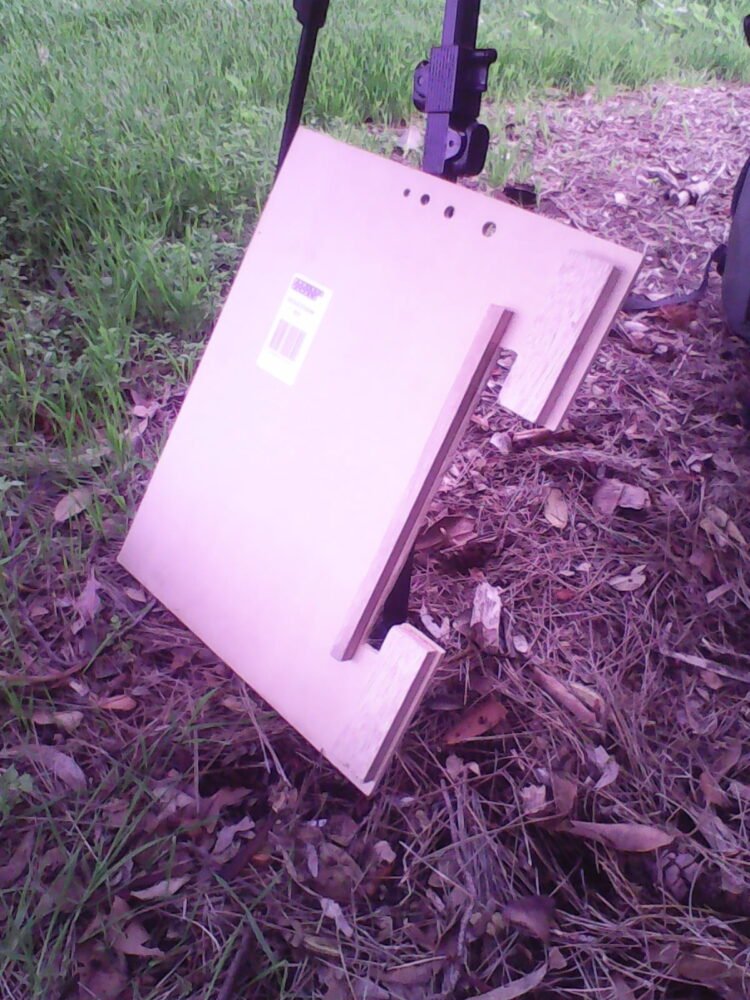
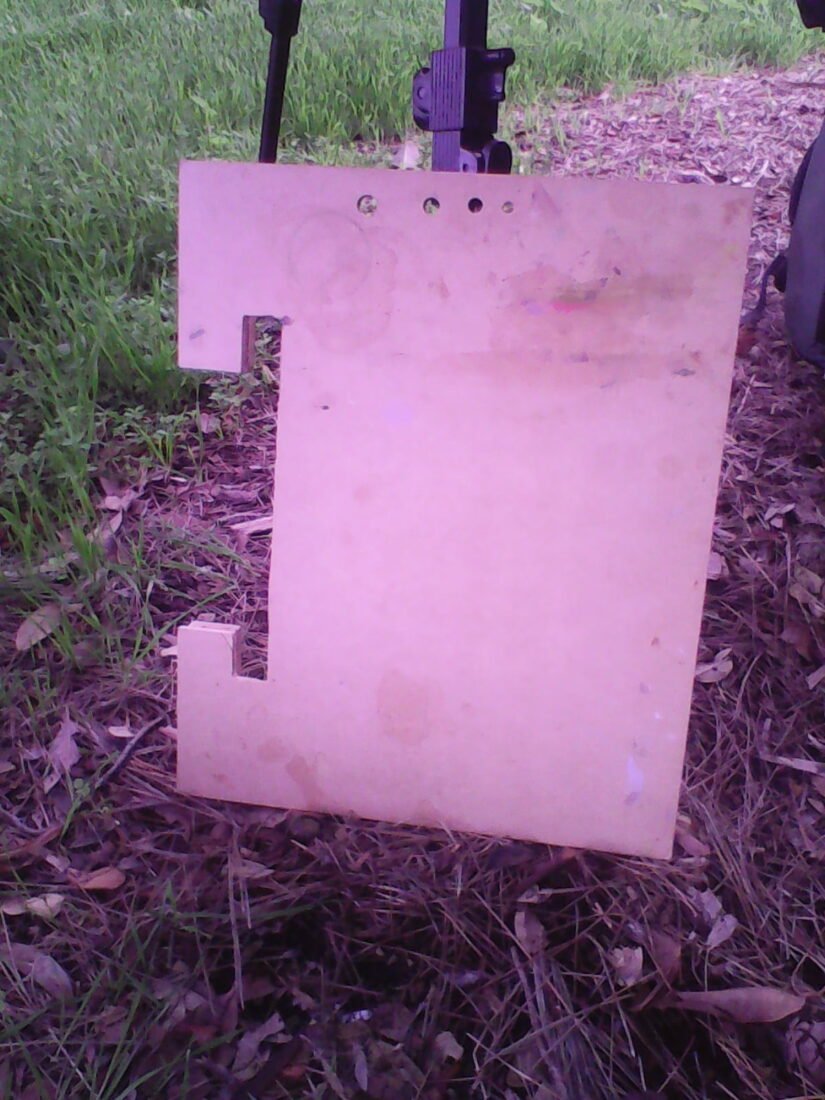
Here is a design for a homemade tray that simply fits over the front of an upright easel and wedges into place. It is quite sturdy and not large or heavy enough to tip the easel forward.
It is cut from medium-density fibreboard, 32cm by 40cm. The size of the cuts into the board for attaching it will depend the dimensions of the easel legs. What holds it horizontal are the pieces of timber glued on the underside of the tray, which cause it to wedge firmly against the legs. Holes have been drilled to hold brushes.
Maybe an inventive person can think of more or different features!
Margaret
Pochade Box
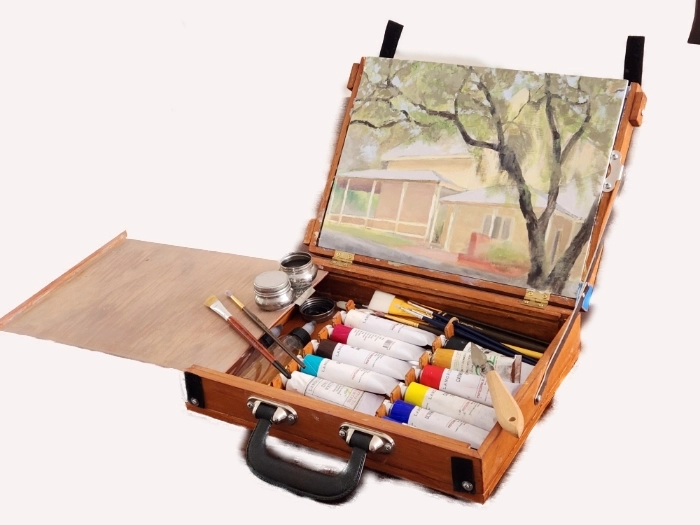
Pochade boxes were popular in the past, they date from the 18th and 19th centuries.
The traditional box is wooden, with a hinged lid at a suitable angle to use as an easel, and also to store paintings. The palette slides to one side for access to the storage space for paints and brushes.
This design was developed from a photo in an old book.
John
Which White?
Some of our lunch time discussion has concerned the choice of white oil paints.
Lead white has become quite expensive, and it can be difficult to obtain, due to its very high toxicity. But some painters still choose to use it, due to its ability to lighten colours without bleaching them.
Recent studies on Zinc white (zinc oxide) have received wide attention on the internet. Although Zinc white had become a safer alternative to Lead white, the studies showed mixtures with Zinc white oil paint quickly become brittle and have severe cracking; it also delaminates, or peels off. Watercolour and acrylics are not affected.
Although Titanium white is a “must have”, it has a very strong cooling effect, and gives a chalky appearance if not controlled well.
Some companies produce a white with Barium Sulphate (sold as Barite or Tinting White), which is semi-transparent and has a low tinting strength. It is not intended for use as a pure white or for making very pale tints, but I found it can lighten colours while retaining their warmth, as shown in these photos.
Another alternative is Lithopone White, a compound of Barium Sulphate and Zinc Sulphide. It was developed in the 1870s as a substitute for the toxic Lead White, and was very popular in the early 1900’s. It’s described as “not as overpowering as Titanium White, but not as gentle as Zinc White”, and “a good alternative for oil painters who have concerns about the permanence of Zinc White, but don’t like the heavy opacity of Titanium White”.
If you have any ideas on this, or other topics, please let us know by using the “Share your tips and ideas” button.
John

Mixtures with Barium Sulphate (Barite or Tinting White)
Mixtures with Titanium White
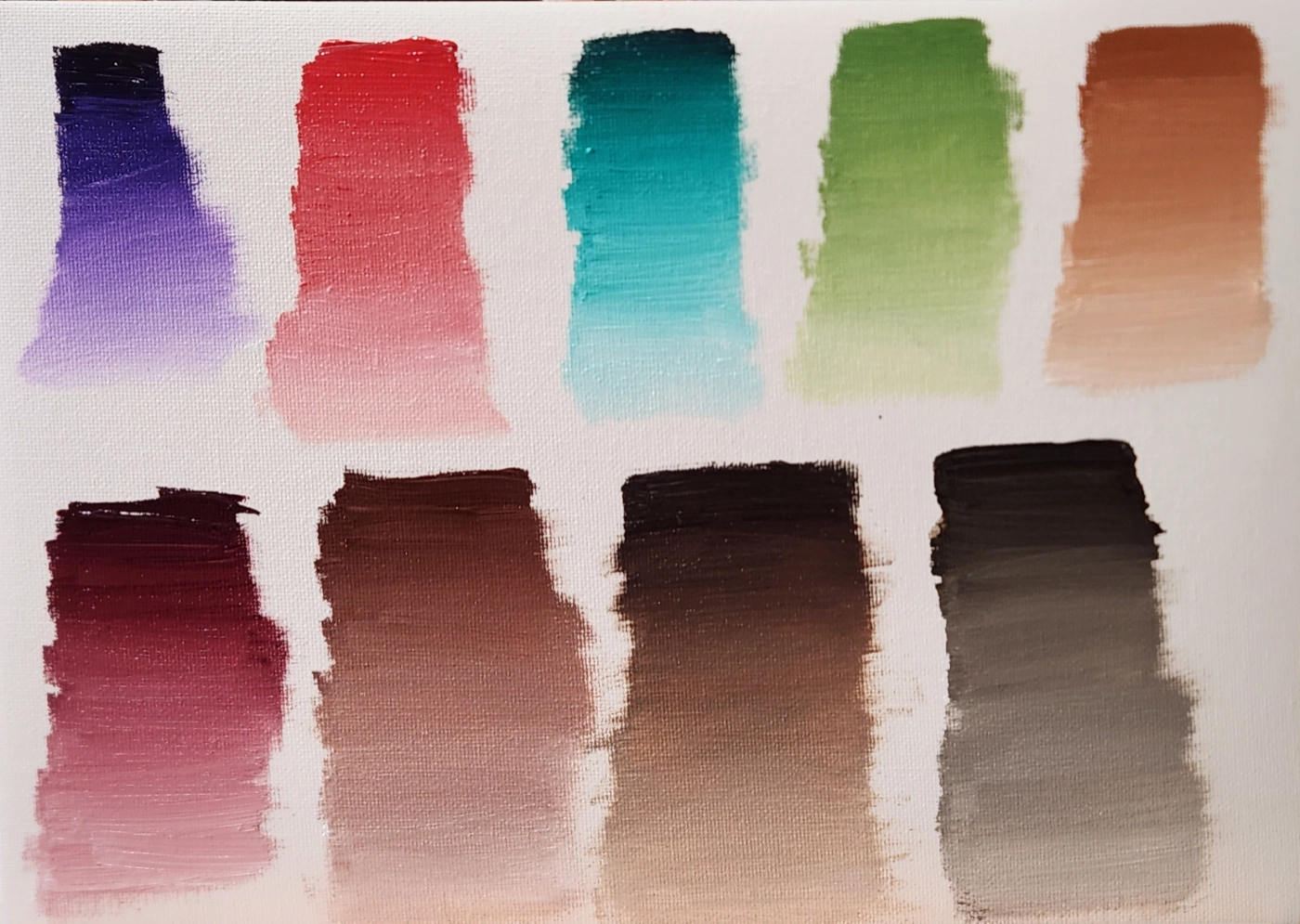
Mixtures with Lithopone White
0 Comments